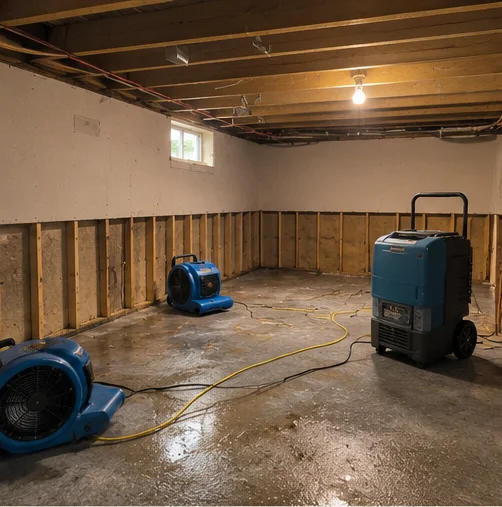
Category 1
Clean at the source. Supply lines, tanks, faucets, ice maker lines.
By Ashburn Resto · October 14, 2026
The highest category has its own page, sewage backup cleanup. Older neighborhoods such as those on our Sterling page see more drain-line backups.
Clean at the source. Supply lines, tanks, faucets, ice maker lines.
Gray, some contamination. Washer and dishwasher drains, sump pit overflow, toilet overflow with urine only.
Black, unsafe. Sewage, storm water, river or ground water.
The industry sorts water by how contaminated it was at the source and how likely it is to make people sick. That sorting tells the crew what protective gear to wear, what to remove and what can be cleaned and dried.
The numbers are a shorthand. They are not a lab test, and a good crew uses judgment as well.
A broken supply line or a leaking water heater releases water that came out of a tap. It starts clean. It is the easiest to handle, and carpet, drywall and flooring can often be dried and kept if the response is quick.
Clean does not stay clean. As water sits and touches dirt, carpet pad and building materials, it picks up contaminants and bacteria grow.
Gray water has contamination that can cause illness if swallowed. Washing machine and dishwasher discharge, sump pit overflow and some toilet overflows fall in this group. Materials that soaked it up may be removed, especially carpet pad.
Because sump water comes out of the ground, it starts at gray. See our sump pump failure page for what that means for a basement.
Black water is grossly contaminated. Sewage backups, flood water and storm water through a wall or window well fall here. Porous materials that touch it are removed, and surfaces are cleaned and sanitized. Crews wear protective gear and seal the work area.
Black water is dangerous to touch or breathe in as spray. Keep children, pets and people with weak immune systems away from it.
Time and contact change the category. Clean water that sits for more than about 48 hours in a structure can step up one category. Gray water that sits can become black. A fast call matters because it can change what has to be removed.
Temperature, how porous the materials are and how much dirt the water carried all play a part. We make the call on site with meters, smell and what the water touched.
On arrival we ask what the water came from and how long it has been there. We look at the materials and smell the room. We take a moisture reading and check for visible dirt or contamination. All of that goes into the category call.
If we are unsure, we treat the water as the higher category until we know more. It costs a little more up front and avoids a mistake that could affect your health.
| Category | Protective gear | Porous materials | Cleaning |
|---|---|---|---|
| 1 | Basic | Often dried in place | Standard |
| 2 | Gloves and boots | Pad removed, carpet depends | Cleaned and treated |
| 3 | Full protective gear | Removed | Cleaned and sanitized |
The gear and the steps change because the risk changes. It is not about charging more. It is about doing the job safely.
Standing water changes with time. Bacteria multiply, and materials leach dirt into it. Water that began clean and sat for more than about 48 hours in a structure is treated as one category dirtier for this reason.
The rule is a guide, not a hard line. A cool basement may slow the change. A warm, humid one speeds it up. We look at the room and the materials, and we notice the smell.
The practical lesson is simple. Call early. A job that starts in the first day is usually smaller, cheaper and less disruptive than the same job that starts on day three.
The categories work as a scale of risk to people. Category 1 is the lowest risk and mostly a drying job. Category 2 asks for gloves and boots, with more removal. Category 3 asks for full gear, sealed work areas and a plan for everything porous.
If you are ever unsure, treat the water as the higher category until someone has looked at it. That habit keeps you safe, and it costs nothing to follow while you wait for help.
When you call, tell us what the water came from and what it touched. A washer hose and a floor drain point to very different plans, even when the puddle looks the same. If you saw dirt, sludge or a smell, say so.
That one detail lets us bring the right gear and set expectations about what stays and what goes before we ever walk in.
It applies the categories to carpet, drywall and flooring, so see what can be saved in a flooded finished basement. The first hour decides how far the water travels, so see what to do in the first hour after a pipe bursts.
No. Protective gear and removal of porous materials are needed. Call a professional.
It starts at Category 2. If it carries sewage or came in as flood water, it is Category 3.
It can affect scope and cost. General information only. Ask your agent.
Not sure what category your water is? Call and describe it.
Call (571) 760-4517