Flooded Basement Cleanup
Pumping out standing water, pulling wet pad and cutting damp drywall before the framing stays wet.
Read more »
Finished basements, winter pipe bursts and clay soil that holds water against foundations are the three things we see most in Ashburn. Water that sits in carpet pad and drywall turns into a mold problem within days, so the first call matters.
Mon–Fri 8 AM–7 PM · 24-hour emergency line
| Category | What it means | Common sources |
|---|---|---|
| 1 | Clean water at the source | Supply line, tank or faucet |
| 2 | Gray water with some contamination | Washer, dishwasher, sump overflow |
| 3 | Black water, unsafe to touch | Sewage, storm water, river or ground water |
Water that sits more than 48 hours moves up one category. Mold can start in 24 to 48 hours.
Call (571) 760-4517Eastern Loudoun County has shrink-swell clay soils that expand when wet and contract when dry, according to the county's own sensitive soils guidance. That movement pushes on foundation walls and opens hairline cracks that stay tight in dry weather. Clay also drains slowly, so water collects against the wall instead of moving away.
Some upland flats over diabase have seasonal perched water tables, a layer of water that sits on top of dense soil after a long rain or snowmelt. A footing drain and sump pit are built to handle that water. When the pump is slow or the power goes out, the pit overflows and the water goes where the floor is lowest.
In a finished basement the carpet pad goes first because it acts like a sponge. Next comes the bottom few inches of drywall, then the baseboard and the bottom plate of the wall. Moisture wicks upward behind paint that still looks dry, which is why we map moisture before anyone decides what to cut.
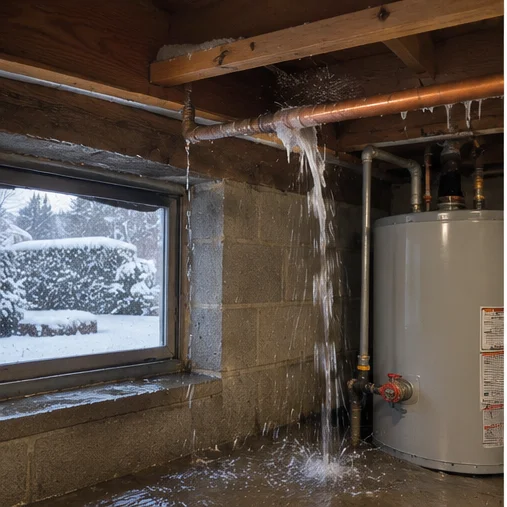
Pipes split on the thaw, not the freeze, and a split line can run for hours before anyone notices. We pull the water and open wet walls, then dry the structure.
Read more »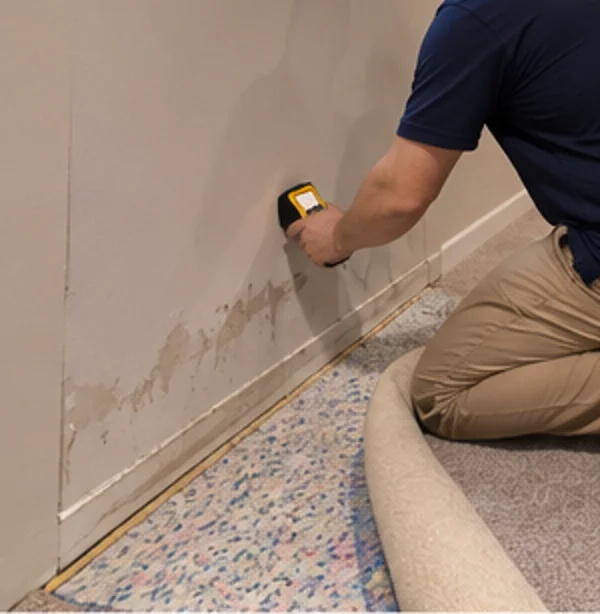
Containment, HEPA air scrubbing and removal of damaged material, followed by steps to keep basement humidity down afterward.
Read more »Pumping out standing water, pulling wet pad and cutting damp drywall before the framing stays wet.
Read more »When the pump quits in a storm or outage, we clear the water and check what the pit left behind.
Read more »Air movers, dehumidifiers and daily moisture readings until studs and subfloor are dry.
Read more »A tank, washer or ice maker line can soak three rooms. We trace where the water went.
Read more »Ceiling stains after snow melt. We dry the attic and the drywall below it.
Read more »Floor drain or toilet backups need protective gear and removal of anything porous.
Read more »Thermal imaging and moisture mapping to find hidden water before walls come apart.
Read more »Cupped boards, wet subfloor and water under LVP. Some floors dry in place, some do not.
Read more »Water through a window well or foundation wall after hard rain, extracted and documented.
Read more »Wet carpet and pad extracted fast, tested, and dried or replaced based on the category.
Read more »Drywall, insulation, trim and flooring replaced after the drying is finished and verified.
Read more »Own or manage a building? See our commercial water damage restoration page for offices, retail space and HOA buildings. You can also browse the full water damage services list.
The month changes the problem. Pick the month closest to now to see what usually goes wrong and which service fits.
Dec to Feb is frozen pipes, hose bibs and ice dams. Mar to Apr brings snowmelt and a heavy load on sump pumps. May to Sep brings thunderstorms, flash floods and power-outage sump failures, and Aug to Oct adds tropical storm remnants. Water heaters, washers and ice maker lines leak all year.
Ashburn was first known as Farmwell, after the mansion of George Lee, a great-grandson of Thomas Lee. In January 1860 the Alexandria, Loudoun & Hampshire Railroad set up a depot at Ashburn Road. That rail bed is now the W&OD Trail.
By 1891 early morning trains through Farmwell carried about 4,000 gallons of milk to Washington each day, and the stop took the name Ashburn in the late 1890s. The farmland those trains served sat on the same clay that today's foundations sit on, which is why the ground still matters.
Washington Dulles International Airport opened in November 1962 next to Sterling.
Sterling water damage »The Virginia Assembly established the town in 1758, so older foundations are common.
Leesburg water damage »Incorporated in January 1879 and named for Commander William Lewis Herndon.
Herndon water damage »Robert E. Simon launched this planned community on April 10, 1964, and its name comes from his initials.
Reston water damage »The Battle of Chantilly, also called Ox Hill, was fought here on September 1, 1862.
Chantilly water damage »This planned community of about 1,500 acres was built largely on wetlands.
Broadlands water damage »Four things set the price of water extraction and drying. The water category matters most, because Category 3 water means removing porous materials and sanitizing. Square footage sets how much equipment runs. The number of drying days depends on how wet the structure got. Materials removed, such as drywall or flooring, add repair work afterward.
Our pricing page has an estimator with typical ranges. Your final price is set after inspection.
Not an emergency? Tell us what happened and we will call you back during office hours.
Shut off the main water valve, then open a faucet on the lowest floor to drain the line. Turn off breakers to any wet basement circuits before you step into water. Take photos, move what you can off the floor, and call us while the water is still draining.
Often, yes. Concrete, framing and most hard surfaces dry in place. Carpet pad, the bottom of the drywall and baseboard are what usually go. The earlier the water is out, the more of the room stays.
The EPA says mold can start growing within 24 to 48 hours on wet materials. Cool, closed basements with wet carpet pad are the worst case. Drying fast matters more than any spray or treatment.
Sump pump and sewer backup are often a separate endorsement, and flood damage is usually a separate policy altogether. This is general information only. Read your policy and ask your agent. We record moisture readings and photos you can share with your insurer.
Many basements need three to five days of equipment time, and heavy jobs with wet framing or concrete run longer. We take moisture readings every day and stop when the structure reads dry, not when a calendar says so.
It depends on the water category, the square footage, the number of drying days and how much material has to come out. Small clean-water jobs sit well below large Category 3 jobs. Use the typical ranges on our pricing page, then call for a price set after inspection.
Water in the house right now? We are on the line.
Call (571) 760-4517