
Cost range estimator
Typical ranges by size and water category
| Affected area | Category 1 | Category 2 | Category 3 |
|---|---|---|---|
| Under 200 sq ft | $450 to $1,200 | $450 to $1,700 | $450 to $2,900 |
| 200 to 500 sq ft | $500 to $3,000 | $650 to $4,200 | $900 to $7,200 |
| 500 to 1,000 sq ft | $1,250 to $6,000 | $1,550 to $8,400 | $2,250 to $14,400 |
| 1,000+ sq ft | $2,500 to $9,600 | $3,150 to $13,400 | $4,500 to $23,000 |
Typical range only. Your price is set after inspection. Figures assume no drywall or flooring removal.
Call (571) 760-4517Cost factors
| Factor | Why it matters | Typical effect |
|---|---|---|
| Water category | Category 3 needs protective gear, removal of porous materials and sanitizing | Raises the typical range |
| Square footage | More area means more equipment and labor | Rises with size |
| Drying days | Wet concrete and framing take longer | Each extra day adds equipment cost |
| Materials removed | Drywall, flooring and insulation removal add labor and repair work | Raises extraction and repair costs |
| Access and floors | Several floors or tight access slow the job | Adds labor |
Why finished basements cost more
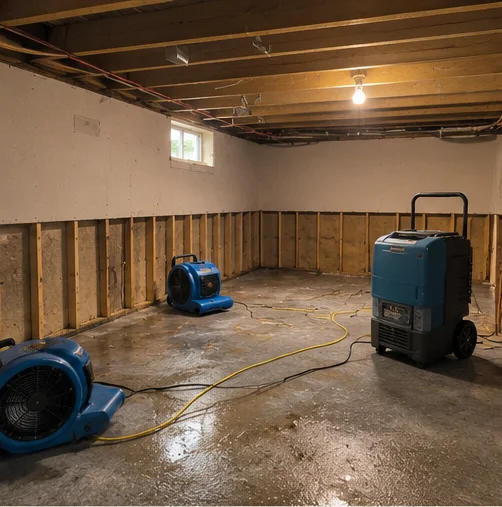
A finished basement has carpet, pad, drywall, insulation and trim between the water and the framing. Each layer has to be checked, and many have to be removed. An unfinished basement with a concrete floor is much simpler.
The room also has more to repair afterward. Drywall, paint, baseboard and flooring all go back, so the second half of the job can cost as much as the first.
Category 3 and sewage
Category 3 water, such as sewage or storm water through a wall, needs protective gear and sealed work areas. Porous materials are removed, and surfaces are sanitized before drying starts. That is more labor and more disposal, so the typical range sits well above clean-water jobs.
Drying days
Many jobs need three to five days of equipment time, and heavy jobs run longer. We take daily readings so the number of days follows the structure and not a guess. Equipment comes out when readings reach the dry standard.
Mold add-on
If mold is found, the job adds containment and air scrubbing, plus removal and often testing. The typical range for mold remediation is higher per square foot than extraction alone. See our mold removal page for how it works.
Insurance basics, general information
Sudden pipe bursts and appliance failures are often covered by homeowners policies. Flood and sewer backup are often separate coverages. Read your policy and talk to your agent. We keep moisture readings and photos you can pass to your insurer.
Typical ranges, in plain words
- A small clean-water leak in one room is a typical range in the low four figures.
- A flooded finished basement with Category 2 water is a typical range in the mid four figures to low five figures.
- Large Category 3 jobs and whole-basement rebuilds can reach a typical range in the five figures.
- Mold remediation typically costs more per square foot than water extraction.
Common questions
CostWhy is there a range and not a price?
Because the final cost depends on what we find after we meter the structure. The estimator shows a typical range only.
CostDoes the range include repair?
The ranges on this page cover extraction and drying, plus the materials-removed adjustment. Rebuild work is priced separately.
InsuranceWill my insurer pay these ranges?
That depends on your policy and the cause of the loss. General information only. Check with your agent.
Want a price set after inspection? Call and we will book the visit.
Call (571) 760-4517